Ketryx for Medical Devices

One Validated Platform, Total Compliance.

Ketryx connects to your existing development tools to automate design history file generation, maintain continuous IEC 62304 and ISO 14971 compliance, and accelerate FDA submissions — without disrupting your engineering workflows.
30 minutes · No commitment · Tailored to your regulatory requirements
Proven at scale in FDA-regulated environments. Trusted by leading medical device and life sciences companies.
The Reality

Traditional compliance is a bottleneck.

Design history files are assembled after the fact, not during development.
Your DHF should document what was built and why — in real time. Instead, teams spend weeks before submissions reconstructing traceability matrices, pulling test evidence from scattered tools, and formatting documents that auditors will question anyway. Every missing trace link is a potential 510(k) deficiency.
Risk management lives in a spreadsheet disconnected from engineering.
ISO 14971 requires risk controls to be verified and traced to design outputs. But when your risk file is a standalone spreadsheet updated quarterly, gaps between what's in the risk analysis and what's actually implemented go undetected — until an auditor or, worse, a patient safety event surfaces them.
Disconnected QMS and development tools slow everything down.
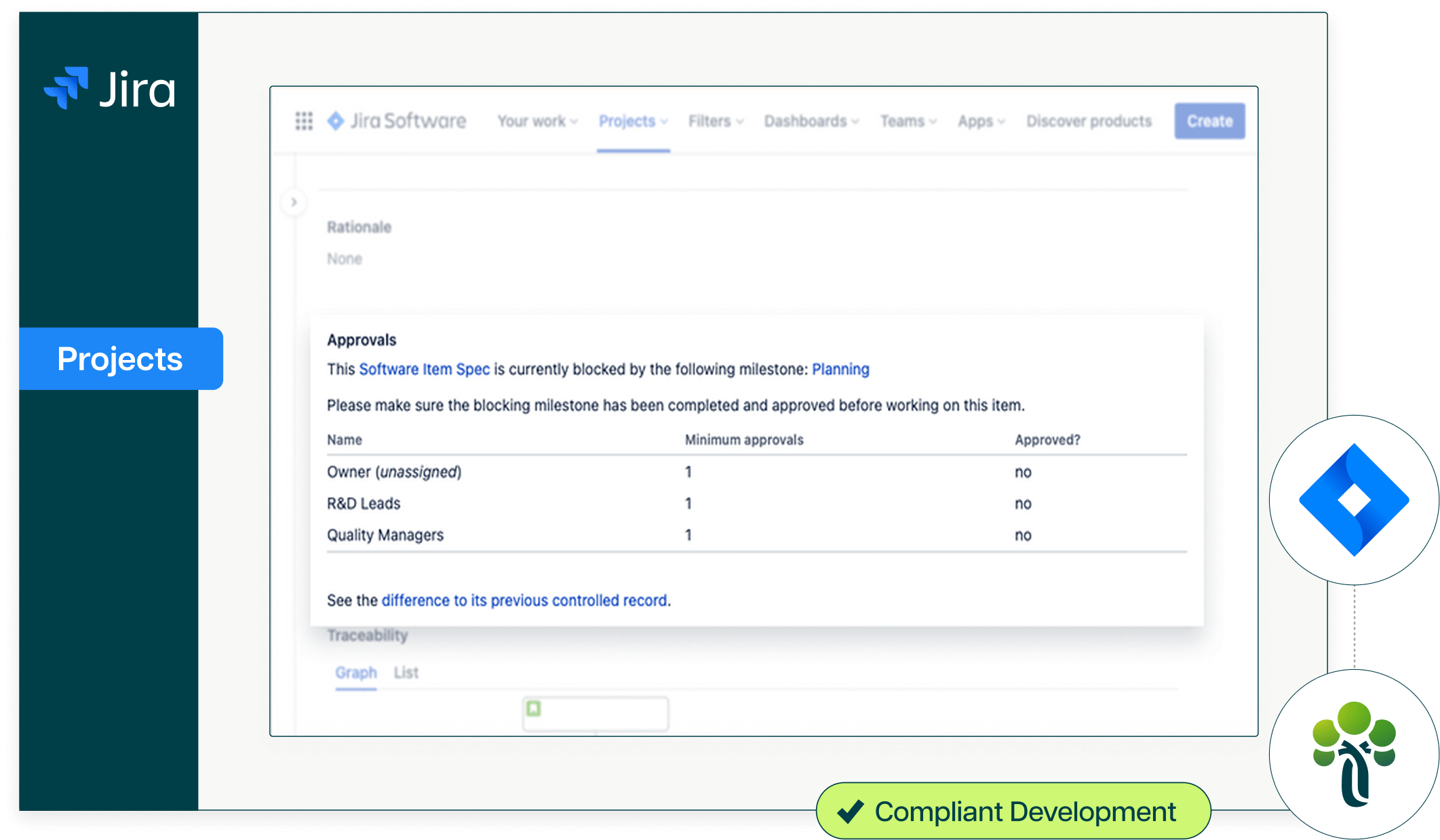
Engineers work in Jira, GitHub, and TestRail. QA/RA teams work in document-centric QMS tools. The result: duplicate data entry, version-control chaos, and a compliance system that never matches what’s actually being built. Every audit becomes a reconciliation exercise.
How Ketryx Works

One platform that connects regulatory compliance to development.

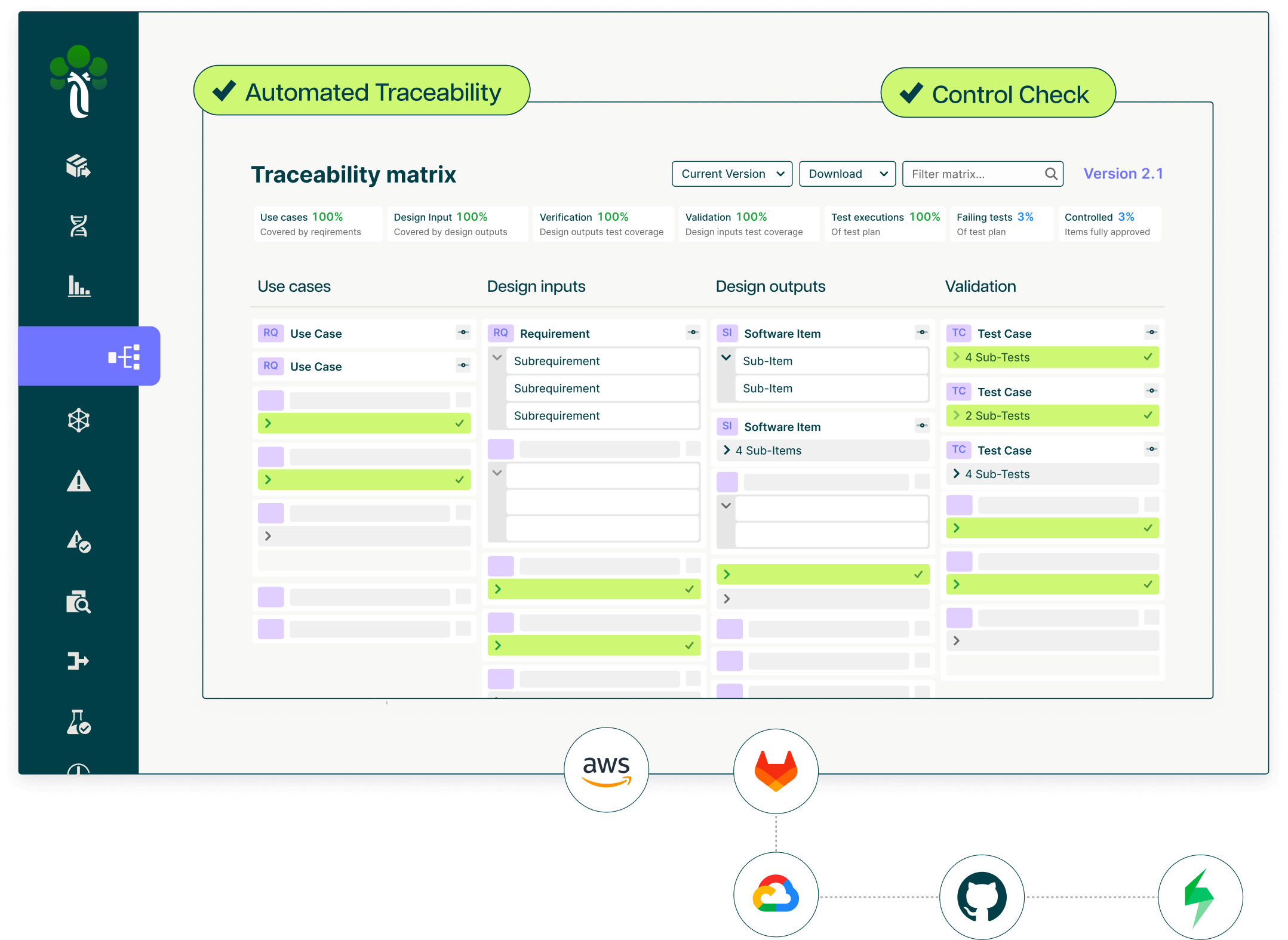
Design history files generated automatically from development activity.

As your engineers write requirements in Jira, push code to GitHub, and execute tests in TestRail, Ketryx generates your DHF deliverables — software requirements specifications, architecture documents, test protocols and reports — aligned to IEC 62304 and your submission format. Your design history builds itself as the product progresses, not in a scramble before the FDA submission deadline.
Live risk traceability from ISO 14971 hazard analysis to verified controls.

Ketryx connects your risk management file directly to design controls, verification evidence, and SOUP/OTS assessments. Every risk control is traced to its implementation and test result in real time. When a hazard's residual risk changes — because a test failed or a requirement shifted — your risk file updates automatically, not three months later.

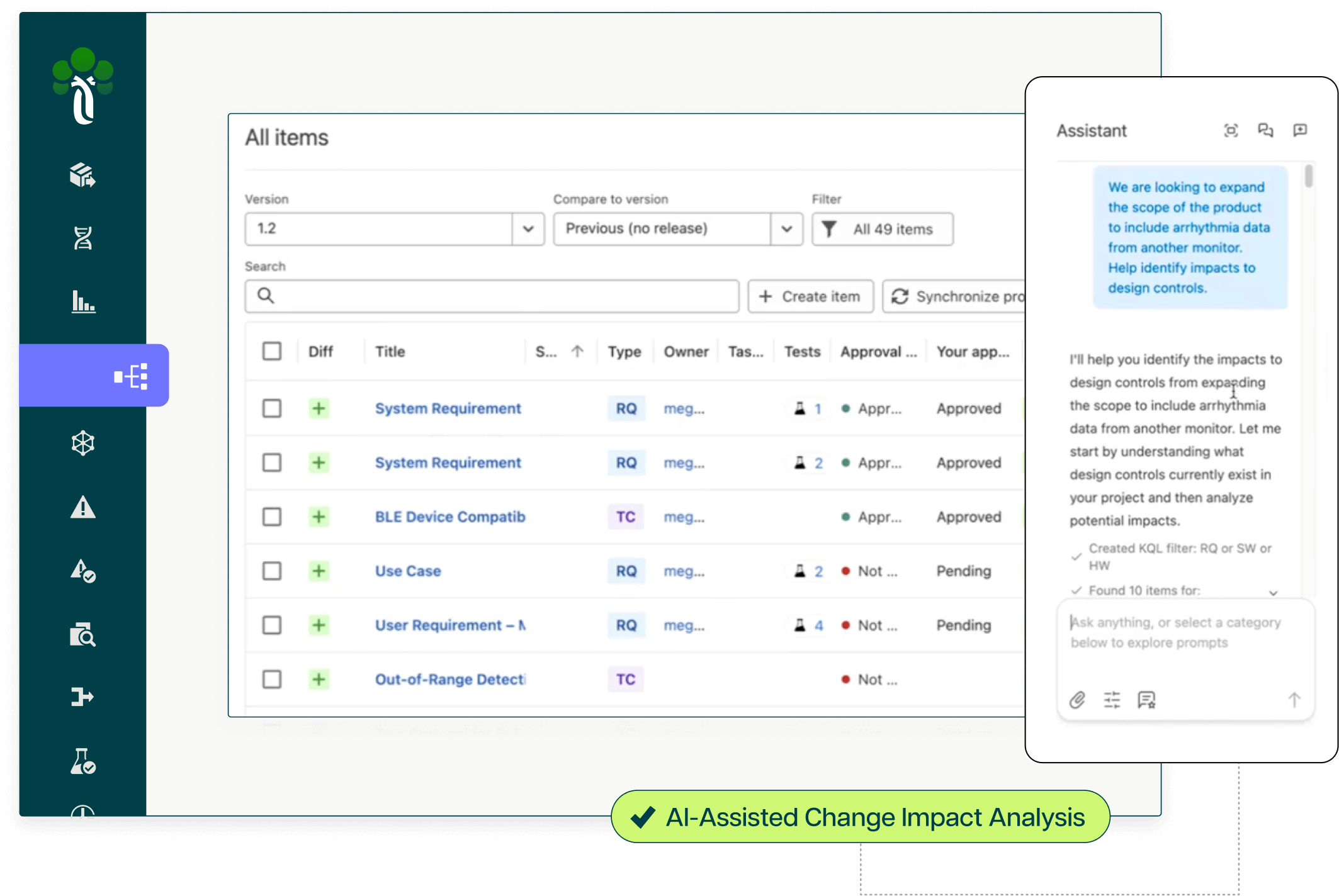
End-to-end traceability with AI agents to transform how your team scopes, reviews, and documents change impacts.

In minutes, the Ketryx Assistant provides a high-level overview of what a proposed change means in the context of your product, project, and team. No more opening dozens of documents to understand scope. Ketryx Agents analyze your DHF, QMS, and regulatory standards to provide specific recommendations. Experts review and take action — with full traceability at every step. When a design input is modified, associated items are automatically flagged. The All Items Page shows exactly what changed and what needs re-verification.
Results

Trusted by four of the top five medical device manufacturers.

0%
Reduction in manual trace matrix maintenance
0%
Audit-ready, 100% of the time
0x
Faster documentation cycles
Hours
Time-to-value, not months
Integrations

Connects to the tools your team already uses.

Ketryx overlays your existing development and compliance tools — no rip-and-replace required. Your engineers stay in the tools they already use.

Compliance Depth

Built for IEC 62304, ISO 14971, ISO 13485, 21 CFR Part 11, and EU MDR

Standard What It Requires How Ketryx Helps
IEC 62304 Software lifecycle processes including planning, requirements analysis, architectural design, implementation, verification, and maintenance — with documentation at every stage scaled to software safety class Automated generation of software lifecycle documentation (SRS, SAD, SDS) from development activity, safety class enforcement, and complete traceability from requirements through verified test results
ISO 14971 Risk management throughout the product lifecycle including hazard identification, risk estimation, risk control implementation, residual risk evaluation, and production/post-production monitoring Live risk traceability from hazard analysis to design controls and verification evidence, automatic risk file updates when controls change, and continuous residual risk monitoring
ISO 13485 Quality management system for medical devices covering design and development controls, document control, CAPA, supplier management, and management review Automated design control documentation, real-time design review readiness, CAPA traceability to affected requirements and tests, eQMS integration for seamless quality workflows
21 CFR Part 11 Electronic records and electronic signatures — audit trails, access controls, system validation, and tamper-evident record integrity for FDA-regulated electronic systems Complete audit trails across all connected tools, role-based access enforcement, electronic signature workflows, and tamper-evident record integrity for every artifact
EU MDR Technical documentation requirements including General Safety and Performance Requirements (GSPRs), clinical evaluation, post-market surveillance, and Unique Device Identification GSPR traceability matrix generation, technical file assembly from development artifacts, and automated post-market surveillance documentation linked to design inputs
FDA 510(k) Premarket submission documentation including substantial equivalence analysis, design verification and validation, software documentation per FDA guidance, and labeling Automated submission package assembly from DHF artifacts, software level of concern documentation, cybersecurity documentation per FDA guidance, and complete V&V evidence packages