Table of Contents
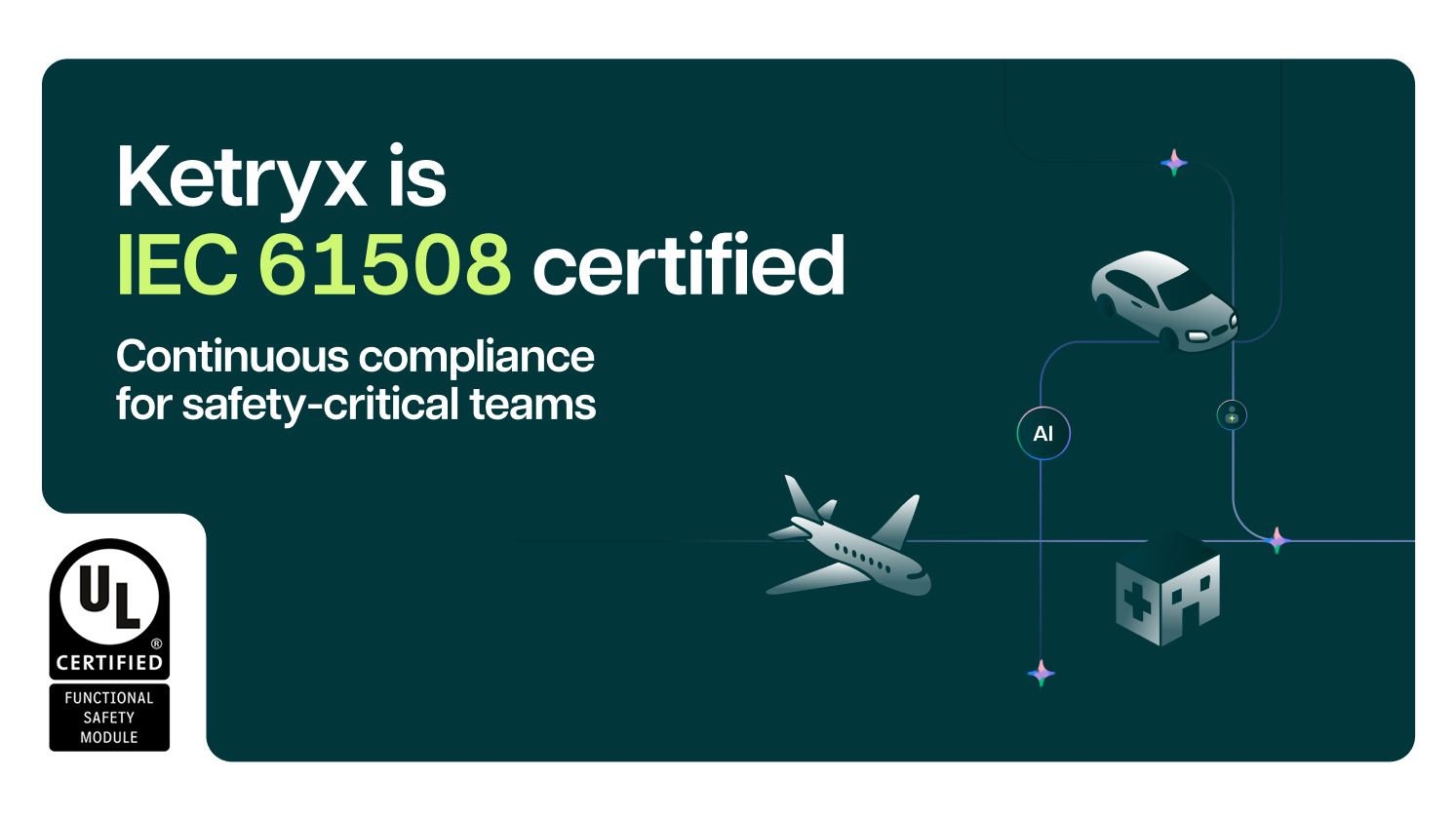
Ketryx is now certified to IEC 61508, the international standard for functional safety of electrical, electronic, and programmable electronic safety-related systems. Teams in automotive, process industries, machinery, robotics, nuclear, and other safety-critical industries can now present the Ketryx certificate as evidence in their tool qualification work. IEC 61508 joins our existing certifications to IEC 62304, ISO 13485, ISO 14971, and ISO/IEC 27001, and our SOC 2 Type 2 report.
Why 61508 certification matters to the teams we work with
Under IEC 61508, companies developing safety-related software must demonstrate confidence in the offline support tools they use, either by qualifying each tool themselves or by assembling evidence that the tool performs as specified and then defending that work before an assessor. Assessors accept supplier documentation as validation evidence, and the Ketryx certificate now serves as submission-ready evidence for every team building on the platform. Teams present it to their assessors once and reuse the same validated evidence across every program.
That ends a large amount of duplicated work. Teams have always treated tool qualification as a fixed cost of operating in a safety-critical industry. Every team building safety-related software on the same platform produced its own validation evidence for it, and every new program produced it again. Each project prompted a re-evaluation of the development platform. This fragmented method added cost and slowed development cycles, and the inconsistent confidence arguments could introduce audit risk. With a certified platform, that evidence exists once, and no team has to generate it.
The same holds as the standards evolve. The sector-specific adaptations, e.g., ISO 26262, IEC 61511, IEC 62061, and IEC 61513, continue to build on the 61508 foundation, and the standards governing AI-driven and autonomous systems are still maturing. Historically, organizations have restructured their programs each time a new standard arrived or a new market opened, regenerating the same validation evidence for the same tools with every revision. Certification at the parent standard removes that cycle, because the confidence argument does not depend on any single revision or sector. A certified platform absorbs those changes once, and every customer inherits the update. Continuous compliance should be viewed as the normal state of a certified system. And it should hold over time as standards are revised and across industries if teams move between sector-specific adaptations.
How the Ketryx platform supported our own certification
The part I am most proud of is how we got here. We certified Ketryx using Ketryx. The only change required was updating our internal SOPs to reflect the new tool classification. Every piece of qualification evidence the assessor asked for, across requirements, risk, test, verification, and documentation, was generated automatically from the certified version of the platform, the same system of record our customers build on every day. We did not rework a single existing document by hand. Instead, the platform natively produced the evidence for its own certification.
How Ketryx helps companies comply with 61508
Ketryx holds safety requirements, risk reduction measures, and verification evidence as structured items rather than as long-form documents, so the safety case exists once.
- The connections an assessor traces, from requirement to risk reduction measure to test to record, are in place before the assessment begins.
- A new regulatory regime is a new rendering of the existing evidence, not a second safety case.
- Documentation for assessors, submissions, or customers is assembled from the lifecycle and regenerates when requirements change.
- Functional safety, reliability, and systems engineering read from the same requirements, traceability, and risk register.
- Customers still write their own safety manual and instructions for use, and Ketryx holds the development and qualification evidence underneath them (read more on document generation).
Scaling for AI adoption in functional safety
So where does AI fit under 61508? A technical file for a safety-related system is long, and answering an assessor's question about it has traditionally meant going through it page by page. With the Ketryx assistant, an engineer types the question the way the assessor asked it and has the answer, with its place in the file, in seconds. Agents go even further. They can be pointed at the applicable sections of 61508 and asked where the biggest gaps are, which hazards have not been accounted for, and which items in the risk register still need a risk reduction measure. Teams can close those gaps during development, long before an assessor ever sees the file, and engineers stay the reviewers of record throughout.
The same rule applies to AI. An assistant or agent used in development is an offline support tool, and teams have been qualifying each one separately, which has kept AI adoption in safety-related development slow. Ketryx is validated as a whole, assistant and agents included, so a team adopting the platform takes on a single piece of validated non-product software. Validation effort should be viewed as belonging to the product, not to the tooling around it.
What’s next
Teams move faster because qualification work shrinks and documentation is automatically generated instead of written. They can build safer systems because agents in a certified platform add a second layer of review alongside their engineers. IEC 61508 certification confirms that both outcomes rest on infrastructure an assessor has already examined, so every team building on Ketryx starts from validated evidence and stays in continuous compliance as standards and programs change. We are proud of this certification and even more excited about what it opens up for the teams building on Ketryx!
Safety-critical development begins with a trusted lifecycle, and Ketryx now holds the certificate to prove it. To learn more, check out this webinar on Jira for IEC 61508, or book a demo.

Lee Chickering is Director of Quality at Ketryx and an expert in quality assurance and regulatory compliance, specializing in bridging quality management and customer success to drive operational excellence in the life sciences industry. With a diverse background spanning manufacturing, project management, and compliance at companies like Amgen, he has led the implementation of Quality Management Systems (QMS) aligned with ISO 13485, ISO 14971, and IEC 62304. Passionate about advancing quality in life sciences, he thrives on collaborating with organizations to enhance efficiency, compliance, and innovation.